Introduction
Days have gone back when business have limited sources to collect data for decision making. The businesses of today’s generation generate a huge data set from multiple applications including APIs, IoT devices, and user interactions. To process and analyze the data collected from different sources efficiently, organizations rely on modern data engineering architectures.
The task of processing and analysing data is based on two main approaches.
- Batch Processing
- Streaming (Real-Time) Processing
Understanding the appropriate use of both these approaches is essential for building scalable, efficient, and future-ready data platforms.
What is Modern Data Engineering Architecture?
Modern data architecture is designed to:
- Manage large-scale data
- Support real-time and batch workloads
- Enable analytics, AI, and reporting
- Managed on cloud and scalable
Typical Architecture Layers:
- Data Sources
- Ingestion Layer
- Processing Layer
- Storage Layer
- Consumption Layer
What is Batch Processing?
Batch processing is the process of collecting and processing data into small segments or groups at regular intervals.
🔹 When Batch Processing Is Used:
- When data is collected at a scheduled time
- It is processed at fixed time (every hour or every day)
- Stored in a data warehouse
🔹 Where this data is used:
- Making business reports
- Financial reconciliation
- Analyzes of old data
- ETL jobs
🔹 Example:
- Daily sales report generated every night.
Understanding Streaming Processing?
Streaming processing manages the data immediately as soon as it is collected.
🔹 How It Works:
- Data is collected continuously
- Processed immediately
- Results available in seconds
🔹 Where Streaming Processing Is Used:
- In detecting fraud
- Managing live dashboards
- Used in systems making recommendations or suggestions
- IoT monitoring
🔹 Example:
-
Detecting suspicious transactions instantly during payment.
Batch vs Streaming – Key Differences
| Feature | Batch | Streaming |
|---|---|---|
| Data Processing | Periodic | Continuous |
| Latency | High | Low |
| Complexity | Low | High |
| Cost | Lower | Higher |
| Use Case | Reporting | Real-time decisions |
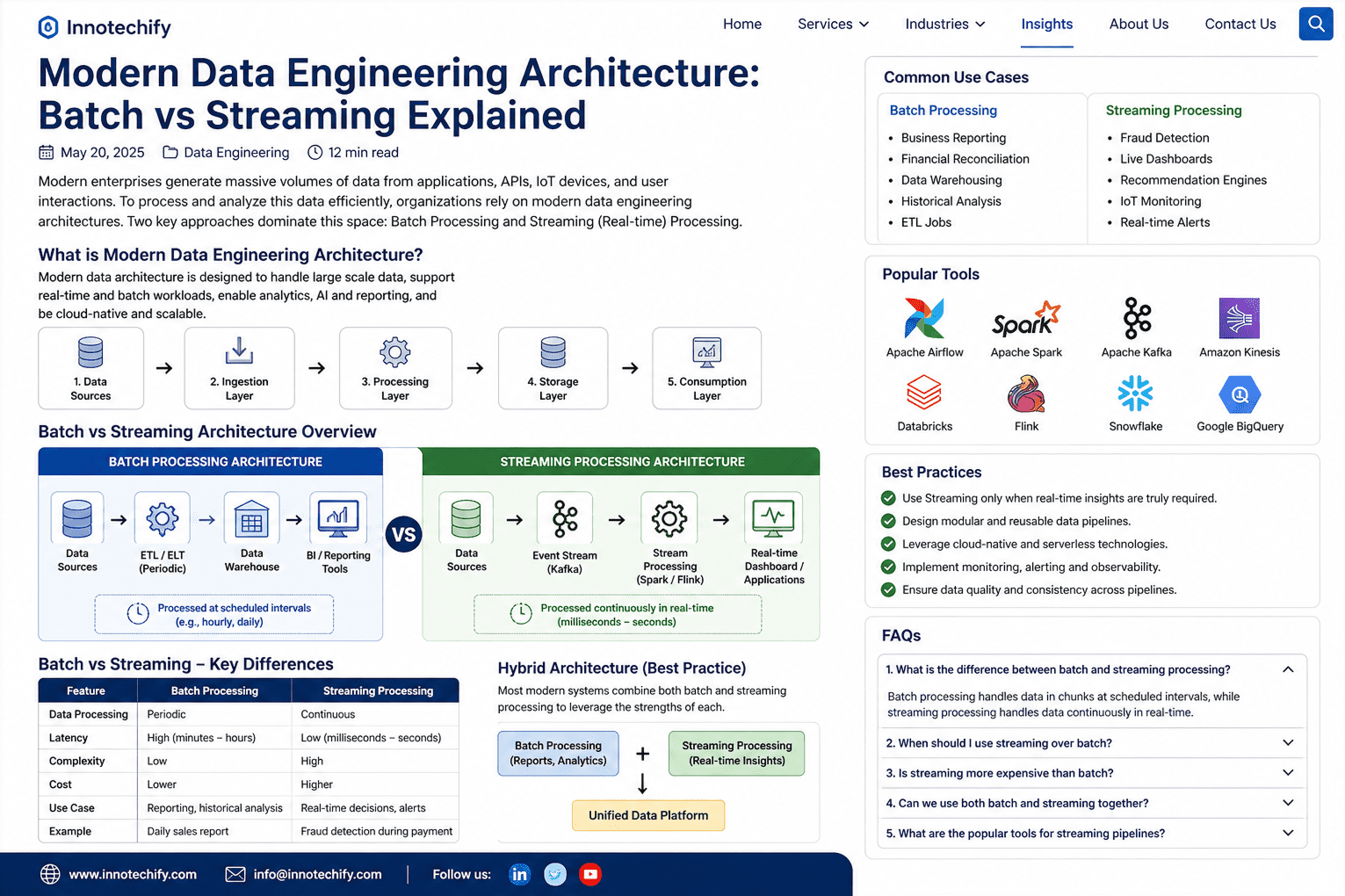
Architecture Comparison (Explained)
Batch Architecture Flow
Data Source → ETL → Data Warehouse → BI Tools
- Uses scheduled jobs
- Suitable for structured data
- Easier to manage
Streaming Architecture Flow
Data Source → Event Stream (Kafka) → Processing (Spark/Flink) → Dashboard
- Event-driven
- Low latency
- More complex
Hybrid Architecture (Best Practice)
Most modern systems combine both:
Example:
- Batch → historical reports
- Streaming → real-time alerts
This is called a Lambda or Hybrid Architecture.
Real-World Enterprise Example Fintech Platform:
Fintech Platform:
- Streaming: Fraud detection (real-time)
- Batch: Monthly financial reports
E-commerce Platform:
- Streaming: Product recommendations
- Batch: Sales analytics
Challenges in Modern Data Architectures:
Data Consistency
Ensuring same data across batch & streaming
Complexity
Streaming systems require advanced setup
Cost Management
Real-time systems can be expensive
Monitoring
Need real-time observability
Best Practices
Use Streaming Only When Needed
Don’t over-engineer
Build Modular Pipelines
Reusable components
Use Cloud-Native Tools
- Kafka
- Spark
- Databricks
Monitor Data Pipelines
Track latency, failures, throughput
Future Trends
- Real-time-first architectures
- AI-driven pipelines
- Server less data processing
- Data mesh architectures
Conclusion
Modern data engineering is no stagnated to only batch processing. Organizations must adopt a hybrid approach combining the features of batch and streaming to support both:
- Real-time decision making
- Historical analytics
Choosing the right architecture depends on the nature of your business, cost, and complexity.
FAQ
What is the difference between batch and streaming data processing?
In batch processing data is process in batches or in small groups at regular intervals. In streaming processing data is processed immediately as soon as it is generated.
When should I use streaming over batch?
Stream processing is useful when low latency and actual results are required.
Is streaming more expensive than batch?
Yes, streaming systems is more complex and expensive.
Can we use both batch and streaming together?
Yes, using a hybrid approach is highly recommended today’s data architecture scenario. Hybrid approach carries the features of both batch processing and streaming.
Modern enterprises generate massive volumes of data from applications, APIs, IoT devices, and user interactions. To process and analyze this data efficiently, organizations rely on modern data engineering architectures. Two key approaches dominate this space: Batch Processing and Streaming (Real-time) Processing.
What is Modern Data Engineering Architecture?
Modern data architecture is designed to handle large scale data, support real-time and batch workloads, enable analytics, Al and reporting, and be cloud-native and scalable.

Data Sources
→

Ingestion
→

Processing
→
Storage
→

Consumption
Batch vs Streaming Architecture Overview
BATCH PROCESSING ARCHITECTURE
Data Sources
→
ETL/ELT (Periodic
→

Warehouse Data
→
BI/Reporting Tools
→
Processed at scheduled intervals (e.g., hourly, daily)
STREAMING PROCESSING ARCHITECTURE

Data Sources
→

Event Stream (Kafka)
→

Stream Processing (Spark/Flink)
→

Real-time Dashboard/Applications
→
Processed continuously in real-time (miliseconds - seconds)
Batch vs Streaming - Key Differences
| Feature | Batch | Streaming |
|---|---|---|
| Data Processing | Periodic | Continuous |
| Latency | High | Low |
| Complexity | Low | High |
| Cost | Lower | Higher |
| Use Case | Reporting | Real-time decisions |
Hybrid Architecture (Best Practice)
Most modern systems combine both batch and streaming processing to leverage the strengths of each.
Unified Data Platform
Common Use Cases
Batch Processing
1. Business Reporting
2. Financial Reconciliation
3. Data Warehousing
4. Historical Analysis
5. ETL Jobs
Streaming Processing
1. Fraud Detection
2. Live Dashboards
3. Recommendation Engines
4. IoT Monitoring
5. Real-time Alerts
Popular Tools

Apache Airflow

Apache Spark

Apache Kafka

Amazon Kinesis

Databricks

Flink

Snowflake

Google BigQuery
Best Practices
- Use Streaming only when real-time are truly required.
- Design modular and reusable data pipelines.
- Leverage cloud-native and serverless technologies.
- Implement monitoring, alerting and observability.
- Ensure data quality and consistency across pipelines
FAQS
What is the difference between batch and streaming data processing?
In batch processing data is process in batches or in small groups at regular intervals. In streaming processing data is processed immediately as soon as it is generated.
When should I use streaming over batch?
Stream processing is useful when low latency and actual results are required.
Is streaming more expensive than batch?
Yes, streaming systems is more complex and expensive.
Can we use both batch and streaming together?
Yes, using a hybrid approach is highly recommended today’s data architecture scenario. Hybrid approach carries the features of both batch processing and streaming.