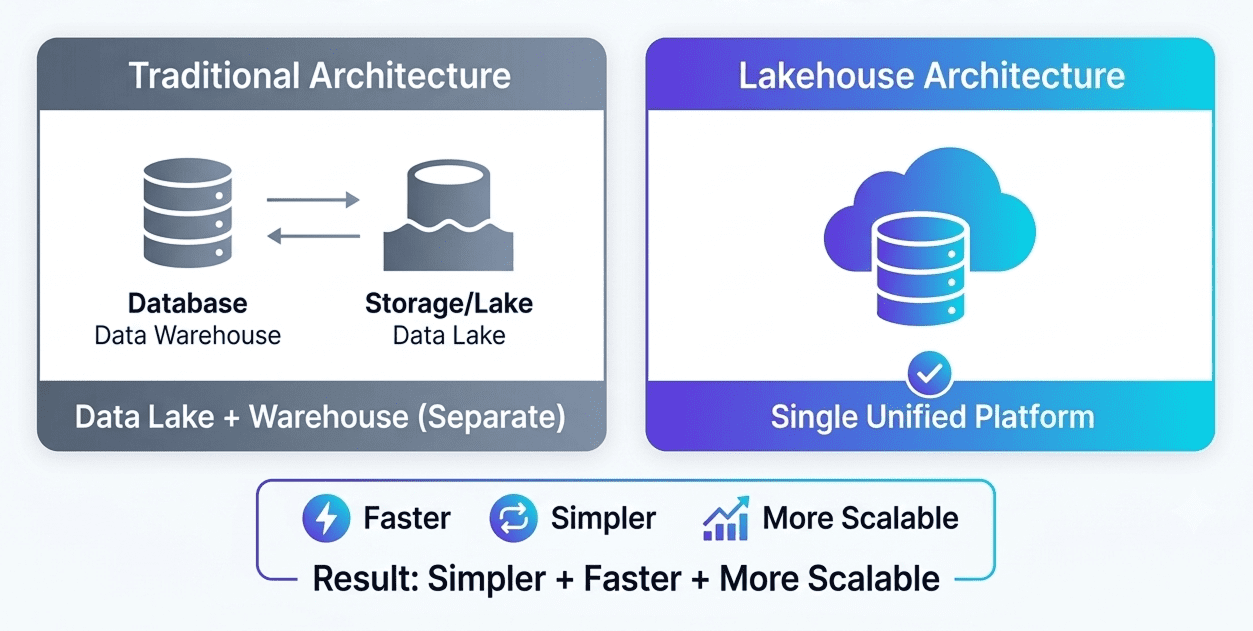
- Data lakes (raw data storage)
- Data warehouses (analytics & reporting)
- Duplicate data
- Increased costs
- Complex pipelines
What Is Lakehouse Architecture?
- Storing all types of data (structured, semi-structured, unstructured)
- Supports analytics and machine learning
- Provides data governance and performance

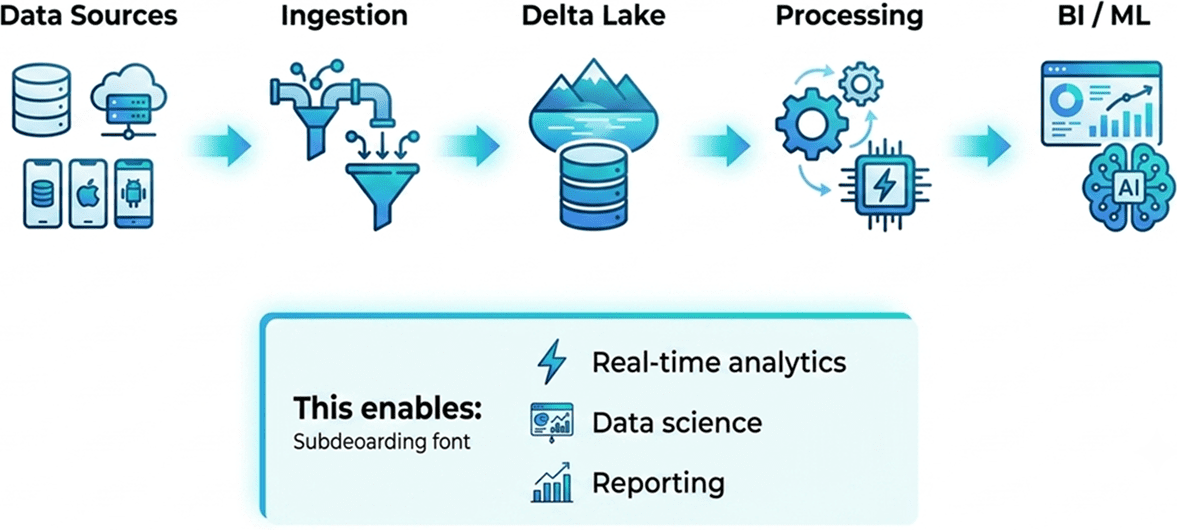
Data Sources
→

Storage
→

Processing
→

BI / ML / AI
Databricks Lakehouse Architecture: An Overview
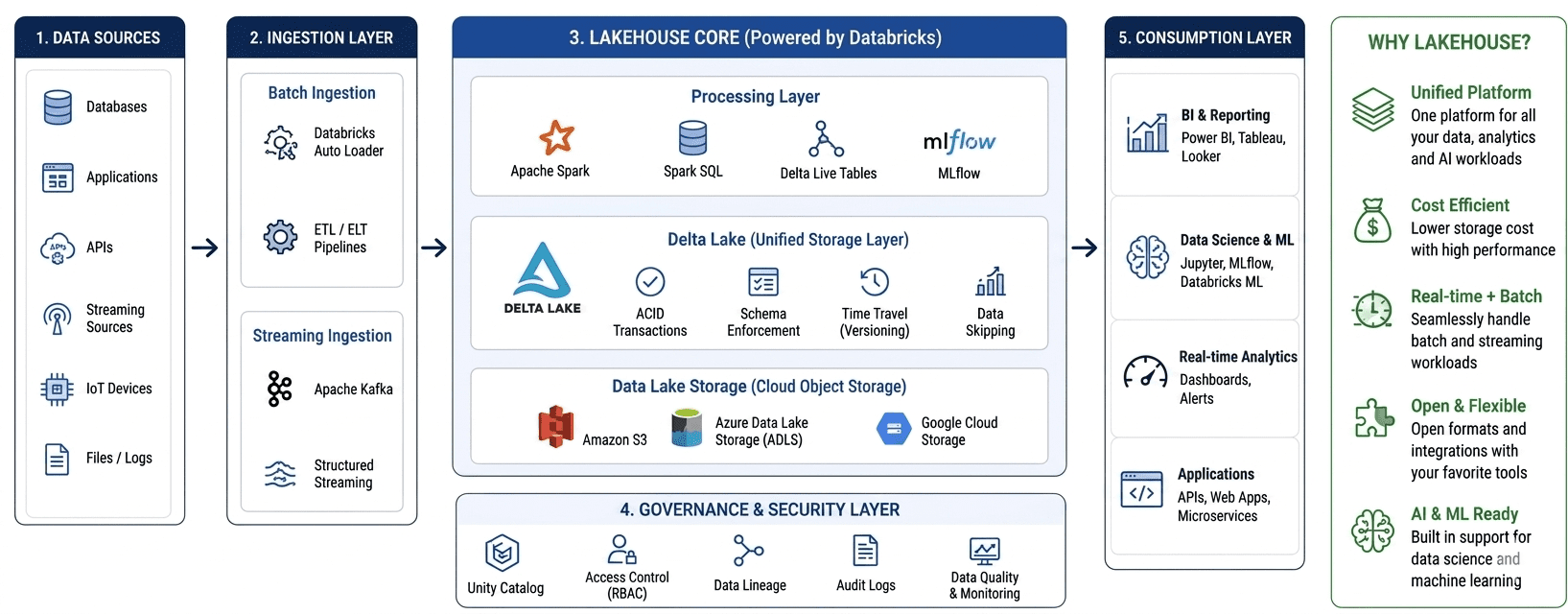
Key Components of Lakehouse Architecture
Data Ingestion Layer
Data is ingested from different sources:
- Databases
- APIs
- Streaming systems
- IoT devices
Supports both:
- Batch ingestion
- Real-time streaming
Storage Layer (Data Lake)
All data is stored in a centralized data lake.
Key Characteristics:
- Cost-effective storage solution
- Supports all types of data
- Scalable
Examples:
- Cloud storage (S3, ADLS)
Processing Layer
Data is processed through distributed computing system.
Technologies:
- Apache Spark
- SQL engines
Used for:
- Data transformation
- Aggregations
- Feature engineering
Delta Lake Layer
Delta Lake works as the cornerstone of Databricks.
Its main features are:
- ACID transactions
- Data versioning
- Schema enforcement
This makes data lakes reliable like warehouses.
Governance Layer
Ensures data security is compliant to government rules and regulations.
Includes:
- Access control
- Data lineage
- Metadata management
Consumption Layer
End users access data via:
- BI tools
- Dashboards
- Machine learning models
Examples:
- Power BI
- Tableau
Data Lake vs Data Warehouse vs Lakehouse
| Feature | Data Lake | Data Warehouse | Lakehouse |
|---|---|---|---|
| Data Type | All | Structured | All |
| Cost | Low | High | Medium |
| Performance | Medium | High | High |
| ML Support | Strong | Limited | Strong |
Benefits of Lakehouse Architecture
Unified Platform
As it combines the features of both data lakes and data warehouse, there is no need for separate systems
Cost Optimization
Minimises the chances of duplicate data and cost of data storage.
Real-Time + Batch Support
Capable of managing both data lakes and data warehouses.
Better Data Governance
Developed in compliance with applicable laws
AI & ML Ready
Supports full machine learning lifecycle
Real-World Use Cases
Financial Services
1. Detecting incidents of fraud
2. Analysing the chances of risks
E-commerce
1. Customer personalization
2. Recommendation engines
Healthcare
1. Analysis of patients data
2. Predictive diagnostics
Lakehouse vs Traditional Architecture
Example Architecture Flow
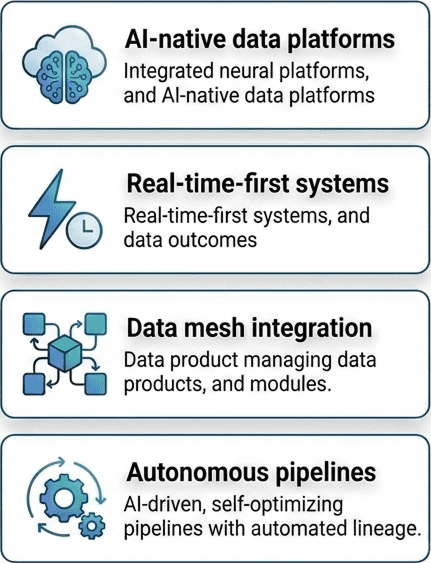
Future of Lakehouse Architecture
Conclusion
- Unifying data storage and analytics
- Reducing complexity
- Enabling AI-driven insights
FAQS
What is Lakehouse architecture?
It is an architecture that carries the features of data lakes and data warehouses on a single platform.
Why is Databricks Lakehouse popular?
Due to the presence of features like analytics, AI, and real-time data provided on a single platform.
What is Delta Lake?
A data storage platform that empower data lakes with features like reliability and improved performance.
Is Lakehouse better than Data Warehouse?
In today’s AI-driven business scenario where businesses have to deal with a huge dataset, data warehouse leads data lakehouse.